From Devighat to the World: Nepal’s Flood Nightmare in a Warming Climate

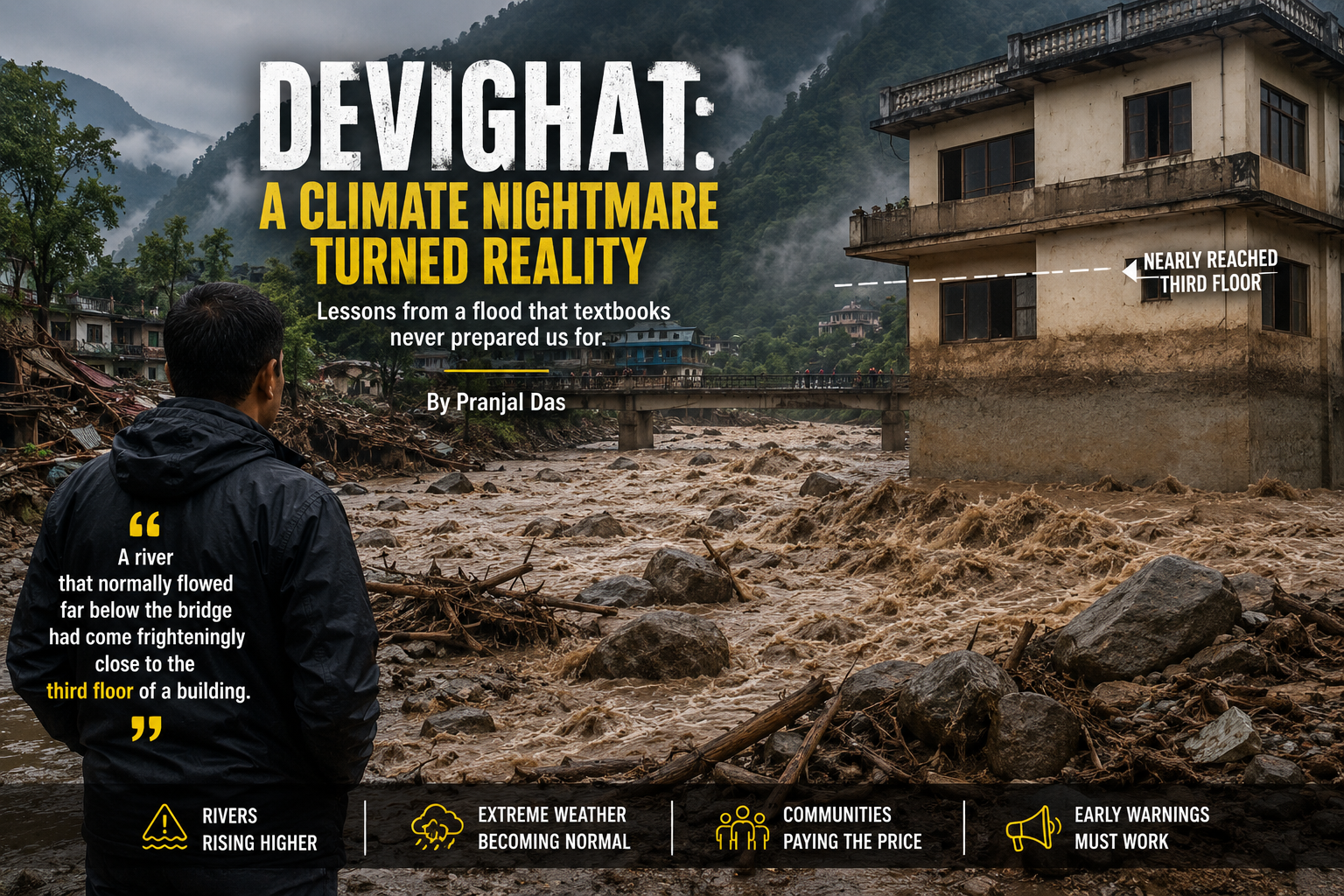
I have studied floods. I have studied rivers, soil, drainage, hydrology, structures and the forces that water can unleash. But nothing I studied in an engineering classroom prepared me for Devighat.
Nothing.
I went there thinking I would see the aftermath of a flood. Instead, I saw what a climate nightmare looks like when it stops being a headline and becomes real.
The river had risen to a level I could barely comprehend. A river that normally flowed far below the bridge had come frighteningly close to the third floor of a building.
Think about that for a moment.
A river.
On the third floor.
And it wasn’t clean water.
It was carrying everything.
Mud. Boulders. Huge rocks. Trees. Broken houses. Household belongings. Animals. Debris.
Lives.
Standing there, I kept looking at the height of the water and thinking about the people who must have been inside those houses when the river came.
Where did they run?
Did they have time?
Did they receive a warning?
Did they manage to take their children with them?
Or did the water simply arrive faster than their fear could turn into action?
I don’t know.
And perhaps that is the most disturbing part.
Because among the mountains of mud and debris are the remains of people and animals.
There are families still looking for people who left home and never came back.
There are people standing in front of what used to be their houses, trying to understand how a lifetime of possessions can disappear in a matter of hours.
You cannot understand that from Facebook.
You cannot understand that from television.
And you certainly cannot understand it from a comfortable room where the biggest inconvenience is a slow internet connection.
Before going to Devighat, I too was looking at disasters through screens.
After standing there, I cannot look at them the same way again.
This is what a warming Nepal looks like
We have become accustomed to hearing phrases like global warming, climate change, extreme weather and climate resilience.
They sound like conference words.
Words spoken at international summits.
Words printed in reports.
But standing in Devighat, those words had faces.
Climate change is not just a graph showing an increase in global temperature.
It is a mother wondering where she will sleep tonight.
It is a farmer looking at a field buried under stones.
It is a family searching through mud.
It is a child who no longer has a home to return to.
And it is a river reaching a place where nobody thought the river could reach.
We must be scientifically honest. We cannot look at one flood and claim that global warming alone caused it.
But we would be equally irresponsible if we looked at a rapidly warming planet, increasingly dangerous climate extremes and Nepal’s extraordinary vulnerability and still behaved as though this is someone else’s problem.
It isn’t.
The climate crisis is no longer knocking on Nepal’s door. It is already inside the house.
And there is a cruel injustice at the heart of it.
Nepal’s contribution to global greenhouse-gas emissions is tiny compared with that of the world’s major historical and present-day emitters.
Yet our people are increasingly being asked to live with the consequences.
The countries that industrialised on fossil fuels cannot simply tell mountain communities to “adapt”.
Adapt with what?
With whose money?
With whose technology?
And how many times are we expected to rebuild?
Climate justice cannot remain a phrase for speeches and international conferences.
For Nepal, climate justice means real money for adaptation.
Real technology.
Real infrastructure.
Real warning systems.
And real cooperation.
A warning system that exists only on paper is not a warning system
This is perhaps the most important lesson we must take from what has happened along Nepal’s northern rivers.
A warning received ten minutes too late is not an early warning.
A warning sitting inside a government office is not an early warning.
A warning system that works perfectly on paper but cannot transmit information across a border is not a warning system.
We learned this painfully in the 2025 Rasuwagadhi flood.
A sudden flood surge came down from the Himalayan region across the Nepal-China border, devastating the area around Rasuwagadhi and the Bhotekoshi corridor. Nepal’s hydrology officials said at the time that they had received no advance warning from China, and there was no established mechanism for such advance flood information.
That should have been enough to wake us up.
It wasn’t.
Now we have witnessed another catastrophic Himalayan disaster.
And once again, the question of cross-border information sharing has come to the forefront. Nepal has been seeking stronger cooperation with China for real-time information and early warnings related to hazards originating in the Himalayan region.
How many more deaths will it take?
How many more destroyed bridges?
How many more hydropower projects?
How many more families searching through debris?
How many more photographs of Nepal under water?
We cannot keep treating cross-border disaster information sharing as a diplomatic talking point.
It must become an operational system.
Immediately.
Nepal, China and India share rivers, watersheds, glaciers and weather systems that do not recognise political boundaries.
A river does not stop at a border checkpoint.
A glacial lake does not wait for a diplomatic meeting.
A flood wave does not ask whether Kathmandu, Beijing or New Delhi has finished discussing a memorandum of understanding.
If a dangerous lake is expanding upstream, Nepal must know.
If an abnormal water discharge is detected, Nepal must know.
If a glacier is showing signs of collapse, Nepal must know.
If extreme rainfall is occurring upstream, Nepal must know.
And the information must reach the people who can actually save lives—not six hours later, not after the river has crossed the border, and not after somebody discovers the disaster through a phone call.
We need a 24-hour cross-border Himalayan disaster-warning mechanism with real-time data sharing, automated alerts, designated contact points, common protocols and direct communication between technical agencies.
This cannot remain merely on paper.
It must be implemented with immediate effect.
Nepal cannot afford to rebuild the same disaster
This is where I speak as an engineer.
A disaster should not only make us ask, “How much relief do we need?”
It should make us ask, “Why were we so vulnerable in the first place?”
Did we understand the floodplain?
Did we properly assess the river’s behaviour?
Were settlements allowed to expand into dangerous areas?
Was the infrastructure designed for the conditions we are likely to face in the future—or only the conditions we experienced in the past?
Did our warning systems reach people in time?
Did local governments have the equipment and trained personnel required to respond?
These are uncomfortable questions.
We need to ask them anyway.
Because if our answer to every disaster is to clear the debris, distribute relief, rebuild the road and wait for the next disaster, then we are not building resilience.
We are rebuilding the same disaster.
Nepal needs climate-informed infrastructure.
We need flood-risk mapping.
We need serious river and watershed management.
We need stronger local disaster-response capacity.
We need resilient bridges, roads and hydropower infrastructure.
And above everything else, we need warning systems that work before the water arrives—not explanations after it destroys everything.
But Devighat also showed me the best of Nepal
In the middle of all that destruction, I saw people running towards the disaster rather than away from it.
Nepal Army personnel.
Nepal Police.
Armed Police Force.
Nepal Scouts.
Volunteers.
Local/International organisations.
Ordinary Nepalis/Foreigners carrying supplies, helping strangers, clearing debris and working through conditions that were dangerous even to stand in.
To every one of them: thank you.
You reminded me that when everything else is washed away, the strength of a country is still its people.
I also want to sincerely thank Prime Minister Balen Shah and the government agencies involved in rescue and relief operations.
I say this as someone who went to the ground.
It is easy to sit safely at home and identify every mistake.
It is much harder to walk through unstable mud and debris, stand beside destroyed settlements and understand what rescue teams are actually facing.
That does not mean governments should escape accountability.
They should not.
If there were failures, investigate them.
If there were delays, understand them.
If something worked, strengthen it.
Accountability and appreciation can exist together.
Today, however, our first duty is to the people who survived.
They need rescue.
They need food.
They need medicine.
They need shelter.
They need their missing family members found.
And they need to know that Nepal has not forgotten them.
The river has given us a warning
As I stood in Devighat, looking at that river, I kept thinking about how small a human being feels in front of nature.
We build bridges.
We build roads.
We build concrete buildings.
We convince ourselves that we have conquered the environment.
Then a river rises.
And suddenly, the third floor is not high enough.
That should humble us.
But it should also wake us up.
I am 25 years old.
I belong to a generation that will inherit the consequences of decisions we did not make.
We will inherit the infrastructure that was built.
The rivers that were altered.
The forests that were protected—or destroyed.
And the climate that today’s world leaves behind.
I do not want my generation to become the generation that only posts condolences after every disaster.
I want us to become the generation that asks difficult questions before the disaster comes.
Why was there no warning?
Why did the warning not reach the people?
Why was information not shared across the border?
Why are we rebuilding vulnerable infrastructure in the same places?
Why are countries that contributed so little to this crisis being left to carry so much of its cost?
And most importantly:
What are we going to do differently now?
Devighat should not become another photograph that disappears from our news feeds in a week.
It should become a national warning.
And the warning should travel far beyond Nepal.
Because somewhere in the world, people are still discussing climate change as if it belongs to the future.
I wish they could stand where I stood.
I wish they could put their feet in that mud.
I wish they could see what remains when a river carries away a lifetime.
Perhaps then they would understand why Nepal cannot wait.
We are not asking the world for pity.
We are asking for responsibility.
We are asking for climate justice.
We are asking our neighbours for information before the water crosses the border.
And we are asking our own government to build systems that work in the real world—not just on paper.
“The river has already given us the warning.
The question is whether we will finally listen.”
(Das is a Civil Engineer, NIT Rourkela/Elected National Youth MP, Parsa-1)