Challenges, Positive aspects, current dreams and working environment of nursing

Nursing is a career based on care. Nurses help people when they need it the most, easing their pain and helping to restore them to health.
For all they sacrifice, nurses deserve more appreciation than anyone can express. In the second week of May, National Nurses Week gives communities, employers, and individuals the opportunity to thank nurses and the nursing profession for all that they do.
As nurses dedicate their lives to caring for others, their own professional and personal needs may fall by the wayside. That’s why organizations like the NAN and dozens of others support and advocate for the more than 110,000 Nepali nurses.
Nursing has undergone dramatic change in response to social needs and influences. Nursing today is different from nursing as it was practiced years ago, and it is expanded to continue changing during the 21st century. Today nursing is a profession with rich career opportunities that change and reflect the society in which nurse live. In the previous days nursing services was limited within the hospital, with the advancement of time and technologies, the role of nurses has expanded as a school health nurse, occupational health nurse, nurse practitioner, nursing administrator, nurse researcher, home care nurse, hospice nurse etc.
The government liberalised nursing education in Nepal in the mid-1990s, and promoted the entry of the private sector into nursing education. Before that, only government-owned institutions provided nursing education, and the government had tight control over the quality and quantity of the nurses produced.
Currently we have different level of nursing education program like ANM, PCL nursing, BN/BNS, B. Sc. Nursing, MN/M. Sc. Nursing and Ph.D. in nursing
According to the data of the Nepal Nursing Council, there are around 110,000 nurses in Nepal, and 73,514 among them are registered with the council. Around 22,000 nurses are employed in government hospitals and 35,000 in private hospitals.
Today nurses are facing various issues and challenges that have been driven by various factors. Brain drain or skill drain is one of the major issues.
As evidence by Nepal Nursing Council record on the distribution of verification letter to work abroad has increased dramatically since 2002 which shows many nurses has taken the letter till 2022. The purpose of this article is to present the challenges, positive aspects and current dreams and working environment of nursing in Nepal.
Few challenges that nurses face in our country are
- Inadequate staffing
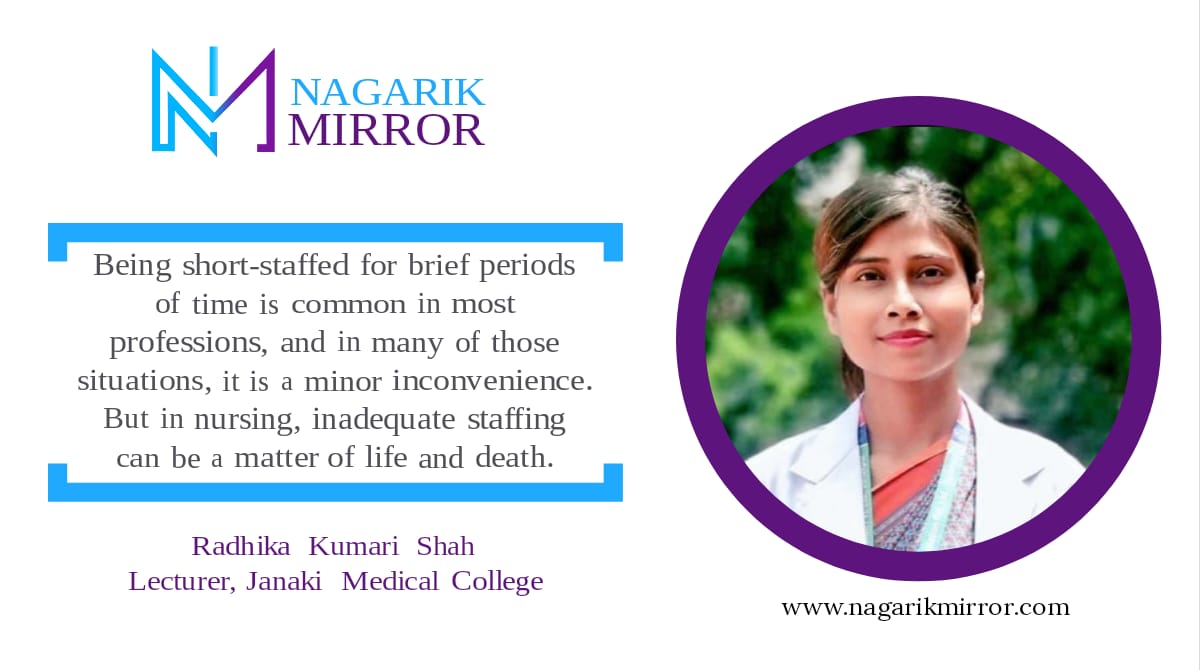
Being short-staffed for brief periods of time is common in most professions, and in many of those situations, it is a minor inconvenience. But in nursing, inadequate staffing can be a matter of life and death.
“Staff shortages brought about by cost-cutting decisions, an aging population, increased patient complexity and need, and an aging workforce place stress on working conditions for nurses and affects patient care and overall outcomes,” the ANA says. “An increasing body of evidence shows appropriate nurse staffing contributes to improved patient outcomes and greater satisfaction for both patients and staff.
- Stress
Job stress refers to those harmful physical and emotional responses that occur when job demands do not match the resources, capabilities, and needs of an employee.1 It can affect all types of workers and all professional occupations.
A hospital based study was done in BPKIHS Dharan on 81 nurses working at critical side showed that shortage of nursing staff (57.7%), too high workload (59.6%), lack of recognition of ones effort (29.8%), aggressive relatives (31.9%), demanding patients (12.6%), poor promotion opportunity (48.9%), lack of support from supervisors(25.5%), poor evaluation system(44.7%), poor nursing administration(40.4%), and low pay scale (31.9%) were the main factors of stress among the nurse in BPKIHS,Nepal.
The emotional and physical demands of caring for others place another burden on nurses. In an ANA survey of 10,688 nurses, 82% indicated they were at a significant level of risk for workplace stress.
To help nurses combat stress, the ANA launched the Healthy Nurse, Healthy Nation™ challenge with the goal of engaging nurses, employers, and organizations around improving health in six areas: mental health, physical activity, nutrition, rest, quality of life, and safety.
“Healthy nurses are great role models for their patients, colleagues, families, and neighbors,” the ANA says.
- Safety on the job
In line with the views of nurses, two main themes as “physical environment regulations” and “administrative arrangements” and six sub-themes (room structures and plans, hygiene conditions, lack of materials, occupational precautions, the attitude of the managers, team collaboration and communication) were determined as the nurses’ health and safety issues on their work environment.
Many factors must come together to create a safe work environment. ANA initiatives to improve workplace safety include:
· Safe patient handling: “Back injuries are always a danger, so ANA mounted a profession-wide effort to reduce them. This campaign includes greater education and training, workplace information on increased use of assistive equipment, and efforts to reshape government ergonomics politics to protect nurses.”
· Safe needles: One-third of ANA members feel that needlestick injuries and blood-borne infections pose a significant level of risk. “While the majority of sharps injuries involve nursing staff,” the organization says, “laboratory staff, physicians, housekeepers, and other healthcare workers can also be at risk and need protection. ANA is working to reduce those risks through education and legislation: arming health care professionals with the guidelines and resources to prevent injuries; and their employers with the ability to create workplace environments where they can do so.
- Workplace violence
Workplace violence has become a public health problem of epidemic proportion that has implications for health-care providers, regulators, consumers, and society at large. To understand the magnitude of the problem facing nurses today, one must recognize that workplace violence includes not only physical assault but a range of disruptive behaviors, such as intimidation and bullying.
Healthcare and social service workers face an increased risk of work-related assaults resulting primarily from violent behavior of their patients, clients, and/or residents,” the Occupational Safety and Health Administration (OSHA) writes in Guidelines for Preventing Workplace Violence for Healthcare and Social Service Workers. “While no specific diagnosis or type of patient predicts future violence, epidemiological studies consistently demonstrate that inpatient and acute psychiatric services, geriatric long-term care settings, high-volume urban emergency departments, and residential and day social services present the highest risks.”
NAN,OSHA, the ANA, and many other organizations are focused on preventing violent incidences through regulations, guidelines, and education. “No staff nurse should have to deal with violence in the workplace, whether from staff, patients, or visitors,” the ANA says.
- Improving self care
This is an issue inextricably linked with the nursing profession.
“‘Care for yourself so you can care for others’ … an age-old adage that is easily forgotten in our jam-packed personal and professional lives. As caregivers, nurses have been socialized to care for others and thus often prioritize their needs as second,” writes Margo Halm, RN, PhD, NEA-BC, in an article published in the American Journal of Critical Care. “Self-care remains vital for nurses to ease the detrimental effects of stress in the constantly and rapidly changing healthcare environment and to prevent progression of those effects to burnout, which can have devastating consequences for nurses and those under their care.”
A full day of pampering may be unrealistic on a routine basis, but the good news is that self-care can be nourishing and lasting when enjoyed in small bites. Go for a walk or a run, visit with friends, work in the garden, read a book by a favorite or new author, binge a few episodes of a TV show, meditate, or practice a little retail therapy. Grab on to what helps you unwind and make it a regular part of your routine.
- Migration of nurses
Every year 250,000 adolescence are accounted to run off from Nepal for advanced livelihood, service, enhanced earnings, proper education system, attracting western standard of living, steadiness and safekeeping as it appears incapable for youths in this country. The migration of nurses is not new in Nepal due to high unemployment and unsecured future in their home country. Underpaid nepali nurses set their sights abroad. The monthly salary of nurses in most private hospitals in Nepal is in the range of Rs10,000 to Rs15,000,
Better working condition and environment, educational opportunities, better remuneration, good educational system, occupation contentment, better professional career, the excellence of organization and authority, political stalemate and conflicts, confrontation, and the menace of violent behavior in the workplace and students can do job, earn and study alongside could be the possible encouraging factors for Nepalese Nurses to wander in a foreign country.