Neglected Disease Prevention: Negligence of the Government or the General Public?

Nepal is a country where there is a constant risk and occurrence of various global diseases. Among them, neglected diseases are not uncommon. Neglected diseases generally refer to illnesses that are ignored at all levels. These are diseases that hold little to no importance for anyone and receive minimal attention.
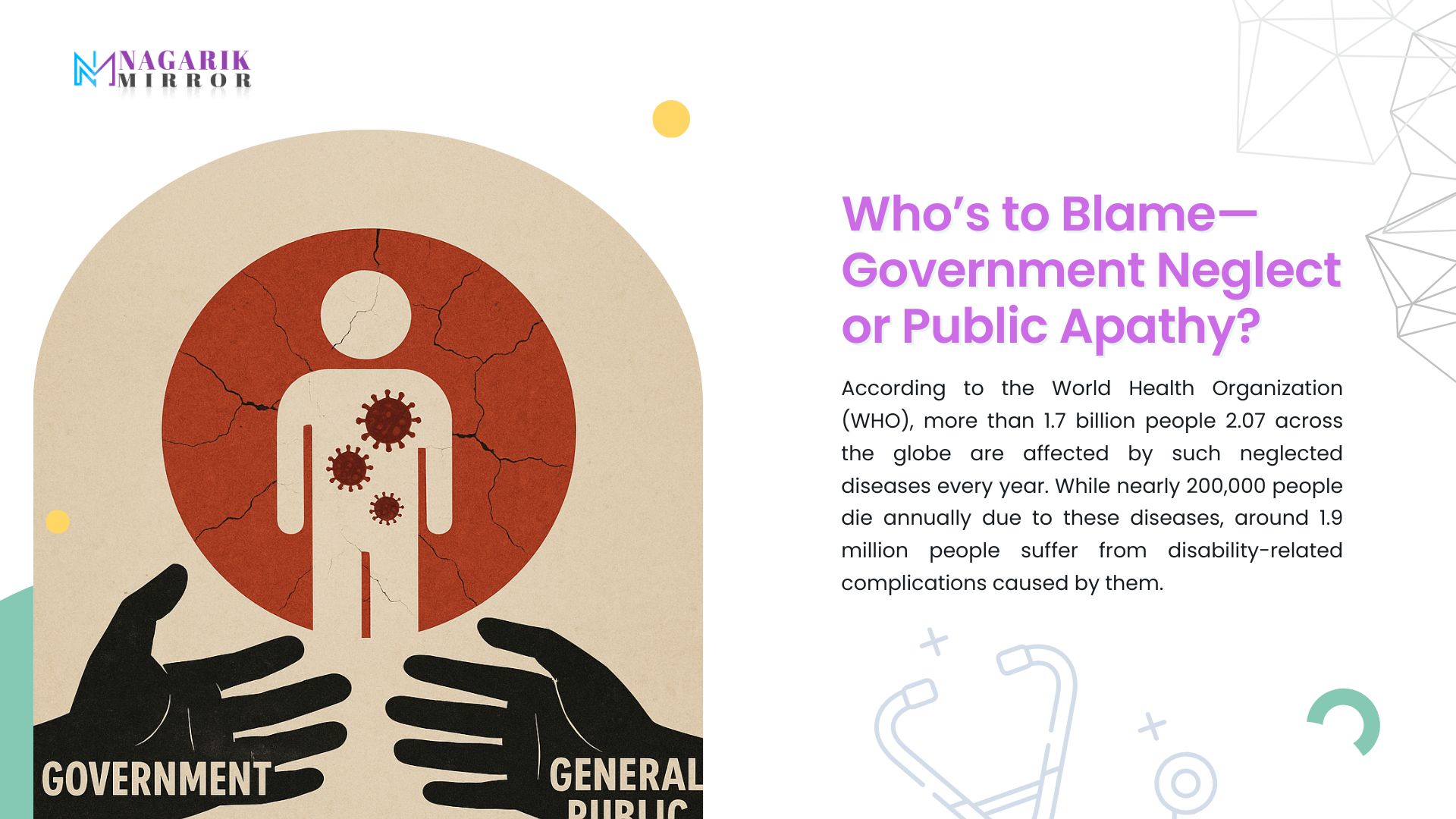
According to the World Health Organization (WHO), more than 1.7 billion people across the globe are affected by such neglected diseases every year. While nearly 200,000 people die annually due to these diseases, around 1.9 million people suffer from disability-related complications caused by them.
The WHO maintains a long list of neglected diseases, which includes vector-borne diseases like dengue, malaria, scrub typhus, kala-azar, and chikungunya. Likewise, diseases such as rabies, measles, Buruli ulcer, leprosy, sleeping sickness, cholera, lymphatic filariasis (elephantiasis), soil-transmitted helminths, diarrhea, snakebites, and scabies are also on this list—totaling around 20 diseases.
In Nepal’s context, these diseases are primarily seen as infectious illnesses that appear more frequently in the summer season. According to Dr. Sher Bahadur Pun, head of the Research Unit at Sukraraj Tropical and Infectious Disease Hospital, rabies, dengue, chikungunya, leprosy, and similar diseases are emerging as neglected diseases in Nepal.
He explains that except for COVID-19, most of the other infectious diseases that tend to appear during summer are considered neglected. These diseases are caused by various viruses, bacteria, parasites, fungi, toxins, and environmental factors.
Dr. Pun states, “Because the government has neglected all the neglected diseases found in Nepal, millions of people are affected by them every year. Until about ten years ago, diseases like dengue, chikungunya, and kala-azar were confined to the Terai region, but now they are being reported in the hilly and mountainous districts too—which is a cause for concern.”
Dr. Pun further adds, “Although the government allocates a budget for other diseases, there is no specific allocation for rabies, dengue, chikungunya, leprosy, kala-azar, cholera, and the like. Since the government treats these as common illnesses, even when people die from them, there is no official data on such deaths.”
Due to this governmental neglect, diseases like kala-azar, cholera, and malaria—which were once considered eliminated—are still being reported in Nepal, and people continue to die from them. The 2018 dengue outbreak affected almost every district in the country, and scrub typhus alone has caused over 100 deaths in the past four years. Government statistics show that eight people died from cholera just last year.
Snakebites cause about 1,000 deaths annually in Nepal, while dengue claims around 50 lives each year. Similarly, about 40 to 50 people die from rabies every year.
Indeed, the government has not taken any substantial initiative to prevent the spread of these infectious diseases. Had there been policy-level efforts, such significant human loss might have been avoided.
Although the government claims to have launched public awareness campaigns for diseases like rabies, dengue, chikungunya, leprosy, kala-azar, and cholera, the impact of these programs has not been as effective as claimed.
According to public health expert Ghanshyam Pokharel, the neglected diseases prevalent in Nepal have not been controlled mainly due to government shortcomings. There is a lack of public awareness and insufficient deployment of trained personnel, keeping the risk of these diseases persistently high.
“Even though the government claims to be working through various programs, the effectiveness of these programs is rarely visible,” Pokharel says. “Due to a shortage of personnel, the programs introduced by the government have not been implemented with the required seriousness.”
He believes that while the programs may look appealing on paper, there has been no monitoring of their actual impact. “Programs have not been advanced effectively or conducted systematically,” he adds.
Due to the lack of a concrete strategy and poor coordination between policies and budgeting, government programs have not proven effective. Pokharel notes, “There is a lack of active community involvement in the programs operated by the government, making it difficult to mobilize communities. This has given neglected diseases a chance to spread.”
Even with a three-tiered government system, the country has not been able to eliminate neglected diseases due to a lack of proper coordination. “We need to regularly monitor whether the established standards are being met or not,” he emphasizes.
To be fair, the government has run programs targeting diseases like elephantiasis and leprosy, which are considered neglected. These include regular medication and free treatment. However, due to a lack of active community participation, many patients hide their conditions for a long time and do not take their medications properly.
The government does conduct periodic studies and research focusing on neglected diseases in Nepal. However, according to Pokharel, the recommendations and findings from those studies are rarely implemented.
On the other hand, the government maintains that the elimination of neglected diseases is a priority and that sufficient programs are in place. Dr. Samir Kumar Adhikari, chief of the Emergency Operations Center at the Ministry of Health and Population, says that a separate division has been established under the Epidemiology and Disease Control Division to address neglected diseases.
According to Dr. Adhikari, diseases such as dengue, kala-azar, and elephantiasis—which are classified as neglected by WHO—are being prioritized through various programs. These efforts are being coordinated across all three levels of government to ensure elimination and control.
To eliminate leprosy, the government has launched door-to-door campaigns to identify patients. For elephantiasis, it is providing preventive medication. Dr. Adhikari also states that campaigns like “search and destroy” are occasionally run to prevent the spread of dengue.
He acknowledges that while the government’s programs may be well-designed, the risk of disease remains because the general public is not fully cooperating. “Just as people followed public health protocols during the COVID-19 pandemic, similar cooperation is needed to eliminate these diseases,” Dr. Adhikari says. “Alongside government efforts, citizens must also take initiative at their level.”
Ensuring accessible health services to all citizens is the government’s basic responsibility. As health is enshrined as a fundamental right in our constitution, the government must lead strong initiatives with public support to eliminate neglected diseases. Because making people aware and safeguarding their lives is ultimately the government’s responsibility.
Why do NTDs still exist?
There are many reasons with NTDs still continue to damage 1.7 billion lives across the world. Here are some of the most prominent problems:
Poverty: Because of poverty, millions of people across the world go hungry and do not receive the nutrients they need to be healthy, which makes them vulnerable to NTDs. As well as this, many NTDs are treatable, but the people who are affected by the diseases cannot afford to travel or be away from their jobs in order to receive treatment.
Water and sanitation: Access to clean water significantly reduces the likelihood of developing an NTD. Some NTDs are transmitted through water, while others prey on people whose immune systems have been compromised by not being able to access clean water and sanitation systems. Many other NTDs require clean water for cleaning wounds and washing the hands and face.
Stigma: A number of NTDs carry a lot of stigma (leprosy being a prime example). Because of the stigma of having an NTD, too many people will hide their symptoms or refuse to come forward for treatment. This allows the disease to continue to be transmitted and has a big impact on the health of the person affected.
Lack of funding and support: Because NTDs affect many of the poorest and most vulnerable communities in the world, their voices are not heard and these diseases are not tackled with the resources that they deserve.
Communication gap: Citizens of Nepal have no information about neglected diseases. The problem is getting worse because the citizens do not know what the neglected disease is and how it affects them. In particular, there is a lack of information about the disease and the services provided by the government to the citizens for neglected diseases.
Not only that, there is no communication between the government and the citizens about what kind of services the government has been providing related to the neglected diseases and how much the citizens have been able to enjoy them. Because of this, citizens are ignorant about neglected diseases.
What is the impact of NTDs?
NTDs have a serious impact on individuals, families, communities, and economies.
The impact on individuals: NTDs can lead to serious ill health and long term disability that can be completely life limiting for those affected. As well as this, NTDs often bring consequences such as stigma and poor mental health. They have the power to ruin more than a billion lives.
The impact on families: Because NTDs can cause such ill health and long term disability, a family’s ability to earn money is affected. As well as this, stigma within a family can cause divisions. In several countries it is still legal to divorce somebody because they have been diagnosed with leprosy. In sub-Saharan Africa, women affected by genital schistosomiasis do not come forward for treatment or speak about the diseases because they fear for their marriages.
The impact on communities: Because many NTDs are communicable diseases, entire communities can be negatively impacted by NTDs as they spread through a local population.
The impact on economies: Because NTDs can have such a devastating impact on health, because they cause long-term disabilities, and because they carry such stigma and mental health challenges, many people are unable to work as they would like. Further to this, many children affected by NTDs struggle to attend school. While these diseases continue to affect more than 1.7 billion people, economies will struggle to grow.
How can we tackle NTDs?
Preventative chemotherapy and transmission control: This intervention aims to make preventative medications widely available. In the case of leprosy, teams across the world are providing doses of an antibiotic called Rifampicin, which acts as a preventative treatment against leprosy.
Intensified diseases management (IDM): This intervention is relevant to diseases for which we do not already have cost-effective control tools and where large-scale use of tools is limited. The aim is that intensified disease management will allow diseases to be easily managed within the primary health-care system.
Vector ecology and management: This intervention refers to the targeting of mosquitos, flies, ticks, bugs and other ‘vectors’ that allow NTDs to be transmitted.
Safe water, sanitation, and hygiene: Clean water and good hygiene are important to the prevention, care, and management of all NTDs. The WHO has called for increased collective action on this area, increased collaboration between the NTD and WASH (Water, Sanitation, and Hygiene) sectors. The WHO has produced a specific WASH strategy to complement the new NTD roadmap.
Veterinary public health services: The health of humans is often tied up with the health of animals and the local environment. Many NTDs are transmitted from animals to humans, so work needs to be done to break the chain of that transmission.
Although the practice of communication is often called upon when intervening and involving communities affected by NTDs, the disciplinary framework of health communication research has been largely absent from NTD strategies. To illustrate how practices conceptualized and developed within the communication field have been applied in the context of NTD elimination, we conducted a scoping review focusing on two diseases currently targeted for elimination by the WHO: lymphatic filariasis and Chagas disease.