The crisis of malnutrition among children in Madhes: 4 out of every 10 children are malnourished

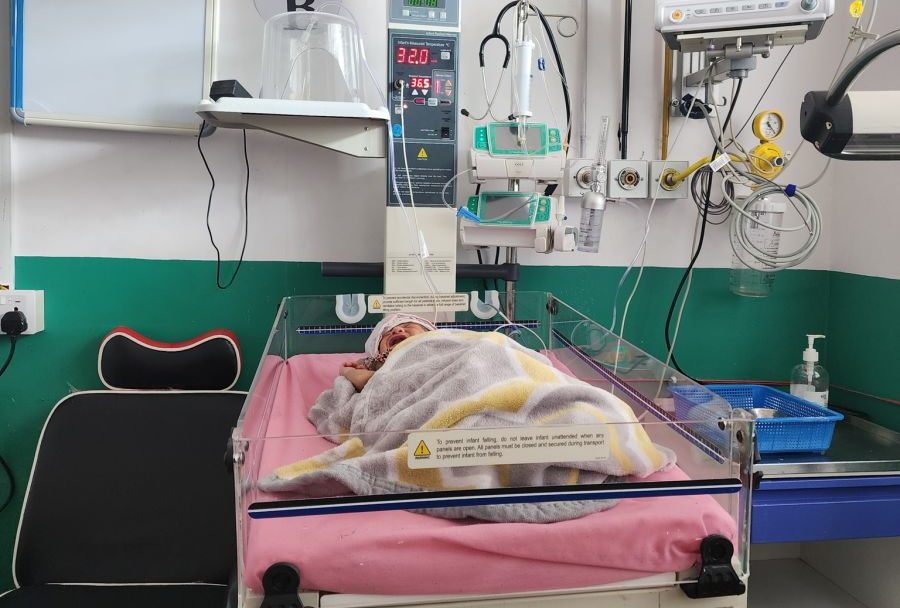
Kathmandu. Chanda Mahato of Danauli, Pipra Rural Municipality in Mahottari, has her 14-month-old infant currently under treatment at the Nutrition Rehabilitation Home in Provincial Hospital, Janakpur. As the child’s body was feverish, showed signs of weakness, and continued to lose weight, Chanda admitted the baby to the nutrition center as per doctor’s advice. Child was admitted 12 days ago, the child’s health is now gradually improving.
Gayatri Kumari Yadav of Mithila Bihari Municipality in Dhanusha returned home after her 15-month-old child treatment at the hospital for 15 days. Child was admitted because weight was continously decreasing and had breathing problems. she admitted the baby to the Nutrition Rehabilitation Home as per the advice of a doctor. After the child’s health improved, she returned home.
Doctors stated that both children showed weight loss and respiratory problems due to malnutrition. These are just two representative cases. In Madhesh Province, 4 out of every 10 children are malnourished. This means 40 out of 100 children suffer from malnutrition, leading to various health complications.
According to the recent data from the Nutrition Rehabilitation Center at the Provincial Hospital in Janakpur, under the Madhesh Institute of Health Sciences, every year around 150 to 250 children are admitted due to malnutrition. Among them, most are also found to be suffering from tuberculosis.
According to Kiran Yadav, the program manager of the Nutrition Center, in the fiscal year 2022/23, 186 children were admitted because of malnutrition which increased to 216 in the year 2023/24.
Similarly, the hospital’s pediatric department receives 150 to 200 patients daily. Out of every 10 children, 4 have some form of malnutrition, says Dr.Baidyanath Thakur.
Dr. Thakur says that the main reasons for child malnutrition are poverty, lack of education, and lack of knowledge about proper nutrition. Children from Dalit and poor communities, who live below the poverty line, are most affected by malnutrition. Even some children from middle-class families are also facing malnutrition issues.
He explains that malnutrition can cause problems related to heart and breathing issues like pneumonia, anemia (lack of blood), and poor brain development. If not treated on time, some children even lose their lives due to these conditions. Dr. Thakur also mentioned that in Madhesh Province, children between six months and five years old are more commonly affected by malnutrition.
Worsening Situation
According to the Nepal Demographic and Health Survey 2022, in Madhesh Province:
· Around 29% of children are stunted (short for their age).
· 27% are underweight,
· 51% suffer from anemia (low blood levels), and
· 10% suffer from severe malnutrition.
These statistics show that the situation of child nutrition in this region is getting worse.
In the 2016 Nepal Demographic and Health Survey, it was found that among children under 5 years of age:
· 37% were stunted (short for their age). ,
· 59% had anemia (low blood),
· 10% were wasted (very thin for their height), and
· 27% were underweight.
According to the Madhesh Province Ministry of Health and Population, about 140,000 babies are born every year in the province. Among them:
· The under-five child mortality rate is 33 per 1,000 live births, and
· The newborn mortality rate is 21 per 1,000 live births.
Malnutrition is understood to be a major cause of these deaths.
This data shows that there has not been much improvement in malnutrition over the past five years.
On the other hand, the Madhesh Province Government says it is working even at the ward level to run nutrition-related programs.
Health Minister Shatrudhan Prasad Singh said: “We have allocated 100 million rupees for nutrition programs. There are Nutrition Rehabilitation Centers in Provincial Hospital Janakpur, Federal Hospital Narayani in Birgunj, and Rajbiraj as well. Also, nutrition programs are being run at the ward level, and a monthly nutrition allowance of 400 rupees is given to children for their nutrition.”
The minister also said that the government provides free treatment for children with severe malnutrition, and it is also running awareness programs and encouraging people to give nutritious food to children.
The provincial government is also running a multi-sector nutrition program, and it aims to make the province free from malnutrition through different awareness and nutrition programs.
Minister Singh said that there are plans to work together with international donor agencies to run more nutrition-related programs.
“Lack of budget, work could not be done”
Overall, the health condition in Madhesh Province is very weak. Especially, the problem of malnutrition is getting worse, according to former Director of the Provincial Health Directorate of Madhesh, Vijay Jha. He said, “From pregnancy itself, mothers should be given nutritious food. After birth, both mother and child need proper nutrition. But in Madhesh, due to lack of attention in this matter, children are becoming malnourished.”
To help such mothers and children, the government has opened nutrition rehabilitation homes, but Jha mentions these are not enough.
In those rehabilitation homes, up to 10 mothers and children can stay for two weeks and receive nutritious food and treatment. However, due to lack of budget, the service is not being provided as per standard stated by Dr.Jha.
Every year, the provincial government allocates 100 million rupees for nutrition programs, including conditional grants from the federal government. But Jha believes that the work done with this budget is not enough, and the budget itself is not sufficient.
In some local areas, NGOs and local governments are also running nutrition programs. The provincial and local governments are also supporting these programs with budgets. However, these programs are still not effective.
“Nutrition programs are being run at the local level, but they are not showing effective results,” said Jha. “There must be strong planning with proper coordination among all three levels of government to solve this problem.”
To protect children from malnutrition, Jha said people need awareness along with proper food. He added that children from poor families should be given nutritious food.
Jha also said that the health of mothers must be looked after to protect children from malnutrition. He said, “Along with children, we must also focus on the mother’s health, her diet, taking iron tablets, pregnancy check-ups, and encouraging early breastfeeding after the child is born.” He suggested that the government needs to work seriously because there are many challenges in making the province free from malnutrition.
Sustainable Development Goal and Madhesh’s Challenge
According to the Sustainable Development Goals (SDGs), the government plans to end preventable deaths of newborns and children under 5 by the year 2030. The target is to reduce newborn deaths to at least 12 and under-5 deaths to at least 24 per 1,000 live births.
However, the high rates of newborn and under-5 child deaths seen in Madhesh Province make it difficult to achieve these goals.
In Madhesh, issues like low education levels, lack of awareness, limited access to safe and nutritious food, and limited access to healthcare have made malnutrition a serious challenge in achieving the Sustainable Development Goals (SDGs).
Due to poor coordination between the provincial government’s budget and programs, the expected work in the nutrition sector has not been achieved. As a result, reducing child mortality — a key SDG target — has become a challenge for the government.
Malnutrition rates can be reduced if identified early.
Dr. Love kumar Sah, a neonatologist and pediatrician at the Provincial Hospital in Janakpur, said that the malnutrition situation in Madhesh is alarming, especially among children from poor and extremely poor families.
He mentioned that the problem becomes more severe because parents are often unaware of nutrition-related issues in time. According to him, the main causes of malnutrition include poverty, illiteracy, early marriage, lack of nutritious food during pregnancy, no regular health check-ups, short gaps between pregnancies, having too many children, and improper food quantity.
He emphasized that malnutrition can be identified in different ways, and awareness programs are needed from all sectors.
He explained that malnutrition can mainly be detected through physical measurements, visible symptoms, food intake records, and lab tests. A simple method includes observing physical symptoms and comparing body measurements with standard levels. This helps easily identify underweight or acute malnutrition. However, to detect deficiencies in micronutrients, lab tests are required.
“Especially during pregnancy, the baby’s weight increases rapidly. During this period, regular monitoring and measurement of weight are needed to assess the nutritional status,” Dr. Sah said. “In the fourth, sixth, eighth, and ninth months of pregnancy, the baby’s growth is estimated based on the mother’s weight.” He added that parents need to be very alert to notice nutrition problems in children.
“Parents should regularly check if their children are growing properly. Whether a child is gaining weight according to age must be monitored every month for the first two years,” he added.
Growth Monitoring Process
Monthly nutrition measurements must be taken, recorded, and compared for analysis. The child’s weight should be measured and recorded according to the growth chart on the child’s health card. The weight graph on the card should show a steady upward trend between the two lines on the chart.
To ensure this, local health institutions and female community health volunteers (FCHVs) should help measure and record the child’s weight, length, height, and mid-upper arm circumference (MUAC).
With the help of local health workers and volunteers, the condition of malnutrition can be identified. If a child is found malnourished, their diet should be changed and treatment given. If everything is normal, the same care should be continued.
Causes of Malnutrition:
· Malnutrition from birth
· Lack of knowledge about nutritious food and healthy eating
· Pregnant mothers not eating or not having access to nutritious food
· Not enough or lack of nutritious food, hunger
· Lack of vitamins and minerals
· Living in an unhealthy environment
· Eating food with pesticides or too much junk/processed food
· Not getting timely health care and services
· Illness, such as children having frequent diarrhea, pneumonia, or getting sick again and again
Ways to Prevent Malnutrition:
· Malnutrition during teenage years (like anemia) can be prevented by eating nutritious food.
· Before pregnancy, regular health checkups and avoiding harmful habits like alcohol, smoking, and unnecessary medicine help prevent malnutrition.
· During pregnancy, following regular health checkups as recommended can help manage malnutrition.
· Pregnant and breastfeeding women should eat more than usual and include food from different food groups.
· Taking iron tablets and regular healthy meals can protect both the baby and the mother from malnutrition.
· Giving newborns colostrum (the thick yellow milk that comes right after birth) immediately after birth, exclusively breastfeeding for the first six months, and giving complementary foods after six months can reduce the chances of malnutrition.
Programs include:
· Maternal, Infant, and Early Childhood Nutrition Program
· Child Nutrition Grant Program
· Multi-Sector Nutrition Program
· Integrated Management of Acute Malnutrition (IMAM)
· Emergency Nutrition Response and Recovery Programs
By checking a baby’s growth every month, early signs of malnutrition can be identified. Using locally available nutritious food, malnutrition can be prevented.
Before and after eating food and after using the toilet, hands should be washed properly with soap and water to stay safe from diseases that spread through dirt. Mothers and babies must be protected from illnesses and infections.
If a child is found to be malnourished, they should be taken to a health center under the Ministry of Health for treatment. There are different programs to prevent malnutrition in babies and children, and people should make use of them.
Climate change and Malnutrition
In 2020, 10 per cent of the population were food insecure (WFP 2020). Changing climatic conditions and extreme weather patterns may increase crop failures or crop damage, which may increase food shortages for subsistence production and disrupt food supply systems. Negative coping strategies tend to disproportionately affect women. Women will often consume less during food shortages as compared to the rest of the family, which can have significant consequences such as undernourishment in pregnant and lactating women.
Targeted nutrition programmes have successfully resulted in a decline in malnutrition over the decades, but the prevalence of malnutrition in children under the age of five remains high (higher than the average – 21.8 per cent – for South Asia). Stunting among children under five years of age is associated with larger family size, being from the Dalit caste/ethnic group, being part of a household from the poorest wealth quintile, residing in rural and mountain regions, coming from a severely food insecure household, and having a mother with a low level of education.
However, the prevalence of undernutrition could easily increase again if food systems are destabilized.
The negative effects of climate change are likely to disproportionately affect those already living in or close to poverty who – because of disruptions to livelihoods – are unable to afford to buy sufficient food, which may be in both rural and urban contexts. For example, the hills and mountains have a higher food energy deficiency than the Terai.
In general, both can be affected if agricultural cycles are perturbed as a result of changing seasonal patterns. Interestingly, urban areas report on average higher food energy deficiency than rural areas (43 per cent and 37 per cent respectively). This is because urban households are dependent on markets to access food, and low incomes force them to buy low-quality, cheaper food, while women even skip meals when incomes fail.