When the Road Disappears: What Rasuwa Reveals about Nepal’s Disaster Resilience
When the road disappears, geography changes.

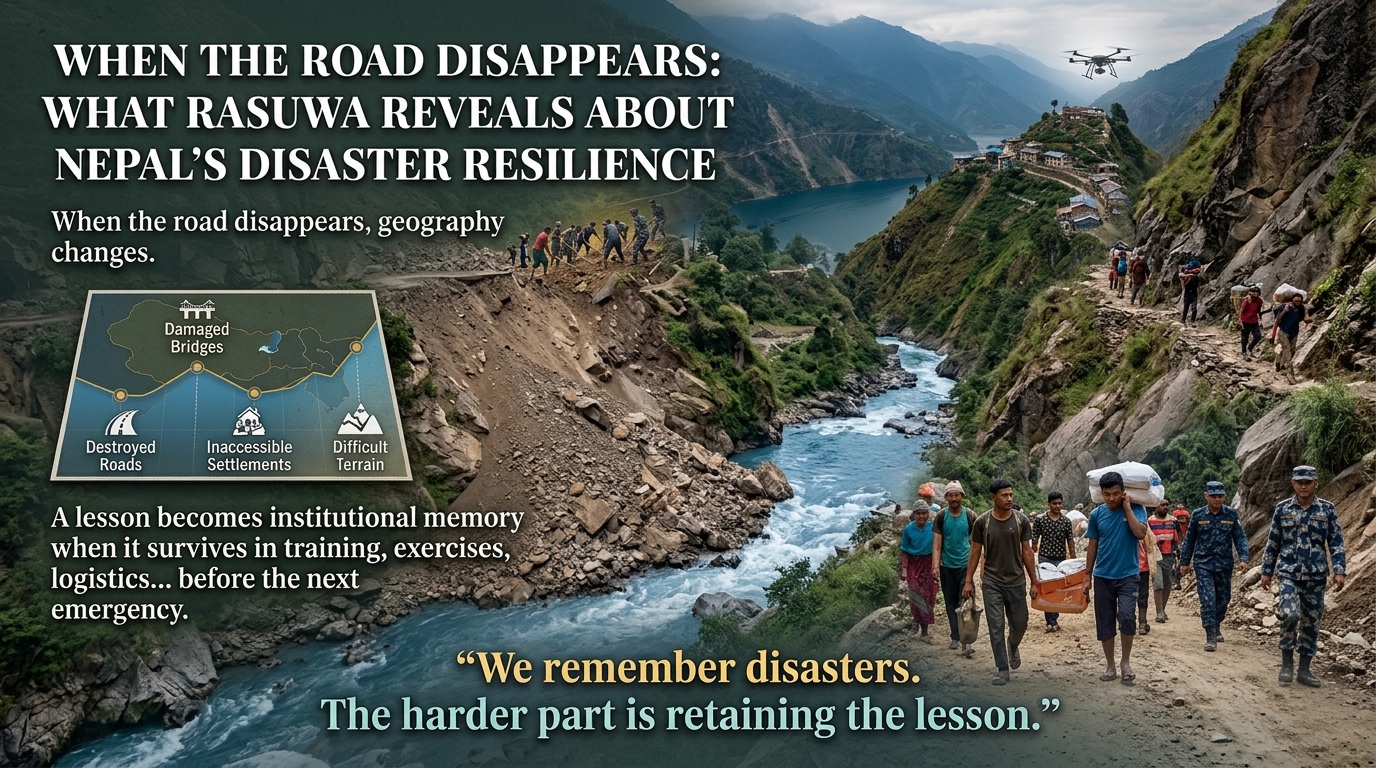
Kathmandu । A place that was accessible in the morning can become isolated by the afternoon. A bridge can become a pile of concrete and steel. A road that connects a district headquarters to a settlement can suddenly become useless. At that point, disaster response becomes less about moving along existing infrastructure and more about finding another way to reach people.
The recent Rasuwa–Nuwakot disaster exposed this reality with unusual force. It also provided a difficult test of Nepal’s disaster-response system.
Nepal does not lack a disaster-management framework. The Disaster Risk Reduction and Management Act, the National Disaster Risk Reduction and Management Authority, security agencies, local governments, early-warning mechanisms and years of experience from earthquakes, floods and landslides provide an institutional foundation.
The harder question is what happens when that system faces several problems at the same time: destroyed roads, damaged bridges, inaccessible settlements, difficult terrain, disrupted communications and rescue operations that continue for days rather than hours.
Rasuwa has shown that Nepal can mobilise. The more important question is whether it can sustain that mobilization.
We remember disasters. The harder part is retaining the lesson.
Nepal has accumulated considerable disaster-response experience. The 2015 earthquake changed how the country understood search and rescue, logistics, international assistance and coordination. Floods and landslides have repeatedly tested local authorities and security agencies.
Yet institutional memory is not simply remembering what happened.
A lesson becomes institutional memory when it survives in training, exercises, logistics, equipment, operating procedures, communications and the way institutions prepare before the next emergency. This distinction matters because disasters do not necessarily repeat themselves in the same form. The next emergency may combine a flood with a landslide, a damaged road network with a hydropower accident, or several geographically separated rescue sites at the same time.
Preparedness therefore has to be measured not only by whether a framework exists, but by whether that framework continues to work when normal access disappears.
The people entering the disaster zone need the technology too
The scale of the security mobilisation during the Rasuwa disaster makes this point particularly clear.
By September 11, 21,022 security personnel had been mobilised for the response: 8,844 from the Nepal Army, 7,975 from Nepal Police and 4,203 from the Armed Police Force.
These personnel were not performing one uniform task. They were involved in search and rescue, body recovery, medical assistance, relief operations, evacuation and operations in difficult terrain. Some operations involved flooded areas and high-altitude locations; others involved the extremely difficult task of searching hydropower tunnels.
This is where the discussion about disaster technology needs to become more practical.
The question is not simply whether Nepal has drones or helicopters. What does a responder have when entering a place where communications may fail, water is moving rapidly, roads no longer exist, visibility is poor and someone may be trapped underground?
Reliable emergency communications matter. So do field-operable drones, thermal and night-vision systems, geospatial and mapping tools, flood and water-rescue equipment, high-altitude rescue equipment, medical evacuation capability and specialised equipment for confined-space or tunnel rescue?
Recent operations have already shown the usefulness of drones. Nepal’s Army has used cargo drones to deliver supplies to inaccessible areas, while drones have also supported reconnaissance and the movement of bodies.
But technology is useful only when it is connected to people, logistics and decisions. A drone without trained operators, batteries, maintenance and a system for acting on the information produces is not a capability. The same is true of communications equipment that cannot function when conventional networks fail.
This is why the technological question should not become a procurement list.
Nepal does not necessarily need to own every specialised capability required for every conceivable disaster. But it needs to know what it cannot afford to be without.
That domestic baseline could include resilient emergency communications, drones for reconnaissance and advance logistics, access to satellite and geospatial information, rapid mapping, weather and hydrological monitoring, flood and landslide detection, and interoperable digital emergency-management systems.
The development and maintenance of such capabilities does not have to come from government alone. Nepalese universities and research institutions, technology companies, security agencies and international partners can all contribute. Universities can provide research and technical talent; private companies can develop or maintain systems; international partners can provide specialised technology and knowledge; security agencies can test whether those systems actually work in the field.
The important point is that technology must shorten the distance between an event, understanding what has happened, making a decision and reaching the affected population.
Aviation is more than the aircraft
Rasuwa also brings Nepal’s air-mobility question back into focus.
When roads disappear, helicopters become more than transport. They become a means of maintaining state access. Nepal’s pilots and aircrews have considerable experience operating in difficult mountain terrain. The recent response again demonstrated the importance of this capability. But aviation resilience is not measured only by the number of aircraft in a fleet.
A helicopter requires trained crews, engineers, fuel, spare parts, maintenance, communications, suitable landing areas, tasking and logistical support. If several difficult sites require air support simultaneously, the question becomes one of capacity and sustainability.
This does not automatically mean Nepal needs to purchase a large new fleet. It does mean that the country can reasonably examine whether its existing aviation resources are sufficient for multiple simultaneous emergencies and whether additional capability is justified by actual operational requirements.
The same principle applies to other equipment. Ownership is not the same as readiness.
Local government is part of the response system
Local governments are often the first institutions to know what is happening on the ground.
They know which settlements are vulnerable, which roads are normally used, where health facilities and shelters are located and which routes remain usable after a disaster. Their role therefore goes beyond distributing relief after the event. They are part of the information system.
A municipality that can quickly communicate what has happened, identify vulnerable communities and provide reliable information to district and national authorities becomes a force multiplier for the entire response system.
This does not mean expecting every municipality to maintain expensive specialist equipment. It means recognising that national response depends partly on the quality of information generated at the local level.
Nepal cannot prepare alone—and does not need to.
Disaster management is usually understood through a cycle of risk reduction or mitigation, preparedness, response and recovery. These stages do not stop at national borders.
For Nepal, regional cooperation is particularly relevant because its risks are connected to geography beyond administrative boundaries. Mountain hazards, weather systems, rivers, seismic risks, climate-related events and humanitarian movement do not respect borders.
South Asia has recognised this for years. The SAARC Comprehensive Framework on Disaster Management established a regional approach covering prevention and mitigation, preparedness, response and recovery, while the SAARC Agreement on Rapid Response to Natural Disasters was intended to facilitate regional assistance, including relief personnel, equipment and search-and-rescue support.
The limitation is that regional frameworks are only as useful as their operationalisation. The existence of the SAARC agreement should not be mistaken for a fully functioning regional response mechanism.
BIMSTEC provides another avenue. Its disaster-management cooperation has included an Expert Group on Disaster Management, regional exercises and work toward a Plan of Action for improving preparedness and coordination. BIMSTEC’s current institutional activity also includes cooperation in weather and climate, science and technology.
For Nepal, these arrangements are not simply diplomatic exercises. Regional cooperation can have practical value in early warning, scientific information, satellite and geospatial data, search and rescue, technical expertise, training, exercises and surge support.
The regional level can therefore become a bridge between Nepal’s domestic capacity and wider international assistance.
International assistance should support national capability
The recent disaster has also demonstrated why Nepal should remain open to international humanitarian assistance. No country can realistically maintain every specialised capability required for every possible disaster. International partners can provide heavy logistics, specialised search and rescue, medical assistance, emergency supplies, technical expertise and additional airlift.
Nepal should welcome such support.
But there is a difference between international assistance supporting a national response and international assistance becoming the foundation of that response.
Receiving assistance is itself a capability.
When a foreign aircraft lands with equipment and specialists, the operation has only begun. Someone has to clear the aircraft, coordinate its personnel, provide transport, arrange fuel and logistics, identify where its capabilities are required and integrate the team into the national command structure. This is where the 4Cs of HADR-command, control, coordination and communication—become more than terminology.
The objective, therefore, should not be complete self-sufficiency. It should be strategic resilience.
Nepal should be able to respond credibly with its own institutions and capabilities in the initial stages of a crisis, while having the systems and relationships required to bring in regional and international support when the scale of the emergency exceeds domestic capacity.
That is a more realistic goal than trying to possess everything. The real test begins after the first response
Rasuwa has shown something important about Nepal
The country can mobilise people. Its security forces can operate in extremely difficult conditions. Its pilots can reach places where roads cannot. Its institutions can bring together domestic and international support. New technologies are already beginning to change what is possible in inaccessible terrain. But the harder test comes after the first dramatic rescue.
Can the system continue when several sites need attention at once?
Can communications continue when networks fail?
Can equipment be maintained and supplied?
Can local information reach national decision-makers quickly enough?
Can Nepal integrate foreign assistance without losing national command and coordination?
And can the lessons from one disaster still be found in training, equipment and procedures when the next disaster arrives years later?
These are not questions of political ideology. They are questions of national resilience the goal should not be to make Nepal independent of every outside capability. That is neither realistic nor necessary. The goal is to build a country that can absorb a major shock without losing the ability to see, decide, reach and sustain .Rasuwa has demonstrated the value of courage and mobilisation. The next stage is capability: better information, usable technology, resilient communications, sustainable aviation, trained personnel, local readiness, regional cooperation and the ability to integrate international support when necessary. Because when the road disappears, the question is not only who can reach the people.
It is who can keep reaching them tomorrow—and the day after that.
That is where disaster response becomes national resilience